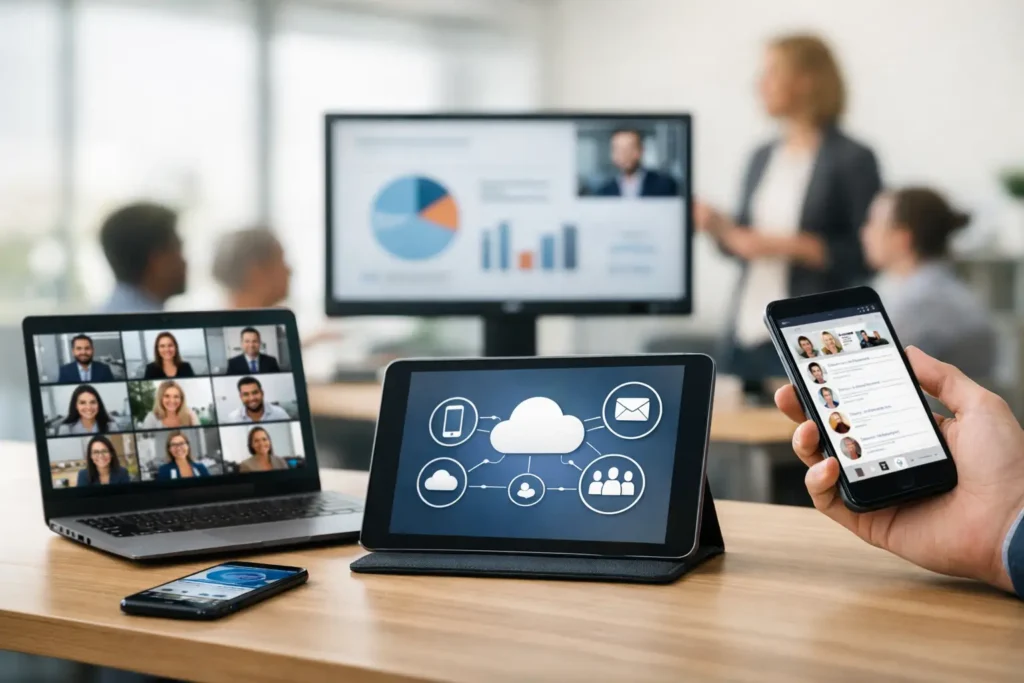
Miss an all-hands update, and the cost shows up fast – duplicated work, missed deadlines, confused managers, and employees filling the gaps with rumors. That is why choosing the best channels for company wide updates is not a branding exercise. It is an operational decision that affects alignment, speed, and trust.
Most organizations do not have a communication problem because they lack tools. They have a channel problem. Too many messages go into places employees ignore, skim, mute, or cannot access at the right moment. The real goal is not to send more updates. It is to make sure the right people actually see, understand, and remember them.
For most companies, the answer is not one perfect channel. It is a controlled mix of channels, each assigned a specific job. Some channels are strong for urgency. Some are better for context. Some are ideal for culture and reinforcement. The mistake is treating them all the same.
What the best channels for company wide updates need to do
A channel earns its place when it improves reach without adding friction. That means employees can see messages in the normal flow of work, leaders can publish quickly, and the business can maintain consistency across locations and teams.
The best channels for company wide updates usually share five traits. They are visible, easy to manage centrally, flexible enough for segmentation, suitable for both urgent and routine messaging, and measurable. If you cannot tell whether an update was viewed, your communications process is running on assumption rather than evidence.
That matters even more in organizations with desk-based staff, hybrid teams, shift workers, or multiple offices. A channel that works beautifully for headquarters may fail completely on the production floor or in distributed teams. So the right question is not simply, “Which channel is best?” It is, “Best for whom, and for what kind of message?”
Email still matters, but it is rarely enough
Email remains useful for formal communication, policy updates, leadership notes, and messages employees may need to search for later. It creates a written record and fits naturally into existing workflows. For detailed updates that require attachments or explanation, email still has a role.
But email is weak when speed and visibility matter. Employees are overloaded. Subject lines compete with customer issues, calendar alerts, and internal threads. Even when an email is opened, that does not mean it was read closely or remembered.
Email works best as a supporting channel, not the only channel. Use it for depth, documentation, and follow-up. Do not rely on it alone for urgent announcements, culture campaigns, or messages that every employee must see.
Chat tools are fast, but they are easy to lose track of
Team chat platforms are excellent for quick updates, local coordination, and discussion. They create immediacy and make it easier for employees to ask questions in the moment. For manager-to-team communication, they are often effective.
As a company-wide update channel, though, chat has limits. High traffic pushes important announcements out of view quickly. Employees mute channels. Remote workers may live in chat, while frontline or shared-device employees may not. The result is uneven reach.
Chat should be treated as a conversation layer, not the primary system for broad organizational messaging. It is useful for amplifying an update, collecting reactions, or helping managers answer questions. It is less reliable as the single source for critical visibility.
Intranet posts are helpful for reference, not attention
An intranet is valuable because it gives communications teams a home base for company news, resources, and archived announcements. It can support longer-form content, leadership updates, policy libraries, and event pages. When employees need to look something up, the intranet can be very effective.
Its challenge is simple: employees usually do not visit an intranet unless they already intend to. That makes it a pull channel. Pull channels are useful, but they do not create guaranteed visibility.
If your goal is awareness, the intranet should store the full story while other channels drive attention to it. Think of it as the reference point rather than the alert system.
Meetings are high-impact, but they do not scale well on their own
Town halls, team huddles, and all-hands meetings give leaders a chance to add tone, context, and credibility. Employees can hear priorities directly, which helps reduce ambiguity. Meetings are especially strong for major business updates, change management, and recognition moments.
Still, meetings have trade-offs. Not everyone attends. Time zones get in the way. Shift schedules complicate access. And even when attendance is strong, employees will forget details unless the message is reinforced elsewhere.
Use meetings for human delivery and alignment, but back them up with channels that extend reach before and after the event.
Mobile notifications work for urgency, with limits
Mobile communication can be powerful when employees are not tied to a desk. It helps with urgent alerts, schedule changes, event reminders, and time-sensitive operational updates. The immediacy is hard to beat.
The issue is saturation. If every message becomes a notification, employees tune out. There are also practical concerns around personal device boundaries, app adoption, and message timing outside work hours.
Mobile should be reserved for messages where speed matters. If everything is urgent, nothing is urgent.
Desktop screens are often the most underused company-wide channel
For desk-based and hybrid organizations, employee computer screens can be one of the best channels for company wide updates because they sit directly in the employee workday. Login screens, wallpapers, screensavers, and instant desktop notifications offer something most other channels struggle to provide: passive visibility without asking employees to open another app, search for another tab, or sift through another inbox.
That matters for messages that need broad reach but do not need a full meeting. Think big sale announcements, KPI progress, culture campaigns, event notices, beta testing updates, benefits reminders, or recognition for a team that just hit a major goal. These are messages employees should see naturally, not only if they happen to check the right channel at the right time.
Desktop messaging also solves a governance problem. When communicators and managers can publish from one control point, brand consistency improves and message distribution becomes easier to manage across departments and locations. If the content can be created in familiar tools and deployed quickly, adoption improves too. That is one reason platforms like ConnectedCompany resonate with communication, HR, operations, and IT teams alike – they turn employee screens into a managed communications system rather than another place where messages may or may not land.
The right answer is a channel mix with clear roles
The strongest internal communications programs do not ask one channel to do everything. They assign jobs. Email handles detail and documentation. Meetings provide context and leadership presence. Chat supports discussion. The intranet stores the full version. Desktop and notification-based channels deliver repeated visibility.
That structure reduces duplication and confusion. It also helps employees learn where to expect what. If an urgent operational notice always appears in one format and routine company news appears in another, trust improves because the system becomes predictable.
A simple way to decide on your mix is to score each channel against four factors: reach, immediacy, relevance, and measurability. Reach asks whether employees will actually encounter the message. Immediacy looks at how fast they will see it. Relevance measures whether you can target teams without fragmenting the message. Measurability tells you whether communication leaders can prove the update was delivered and viewed.
How to choose the best channel for each update
Start with the message itself. Is it urgent or routine? Does it affect everyone or a specific segment? Does it require discussion, or only awareness? Does it need to be remembered for one day or one month?
If the message is urgent and broad, use a push-style channel that employees will notice immediately, then follow with detail elsewhere. If the message is important but not urgent, use a visible reinforcement channel supported by email or intranet content. If the message is cultural, celebratory, or recurring, choose a format that creates repetition without becoming annoying.
This is where many teams overcomplicate things. They debate features instead of workflow. The real test is practical: can your team create the update in minutes, publish it centrally, target the right audience, and confirm it was seen? If the answer is no, the channel may be impressive on paper but weak in daily operations.
A good company-wide communication system should feel controlled, simple, and repeatable. Create. Share. Communicate. Then measure what happened and adjust.
The best channel is the one your employees actually see and your team can manage without friction. If you build your channel mix around that standard, company-wide updates stop feeling like a broadcast problem and start working like an alignment system.