At 9:07 a.m., you send the update that matters: a safety reminder, a policy change, a KPI push, a site closure, a recognition moment. By 9:20, it is buried under email threads, muted chat channels, and meeting invites. The message did not fail because it was unclear. It failed because it never got seen.
That is the problem employee desktop communication software is built to solve. It turns the most consistent surface in your organization – the employee computer screen – into a managed communications channel you can actually control.
What employee desktop communication software really is
Employee desktop communication software is not “more messaging.” It is an internal channel that uses the desktop itself to distribute company and team communications through elements employees naturally encounter: wallpapers, lock and login screens, screensavers, on-screen notifications, and sometimes short-form video.
The key idea is reach without asking employees to change behavior. You are not requesting, “Please open the intranet” or “Check the channel when you can.” The channel shows up where work already happens. That makes it especially valuable for distributed teams, multiple locations, and mixed schedules where traditional comms tools perform inconsistently.
A good desktop channel also creates governance. Instead of a patchwork of local posters, ad hoc email blasts, and inconsistent Teams messages, you centralize content, targeting, and timing. Communication becomes a controlled system, not an act of hope.
Why desktops beat inboxes for certain messages
Email is great for documentation and long-form detail. Chat is great for collaboration. Neither is designed to be a reliable broadcast channel.
Email competes with everything else in the inbox and is easy to ignore. Chat notifications become background noise, and many organizations intentionally reduce chat pings to protect focus. In practice, that means your most important operational messages – “read this now,” “remember this today,” “do this before Friday” – often land in the same bucket as everything else.
Desktop communication changes the physics. The wallpaper or lock screen is persistent. The screensaver is unavoidable when someone steps away. A push notification can be urgent without becoming a new thread that spirals into discussion. You get high visibility without turning every update into a conversation.
This does not replace email or chat. It gives you an accountable broadcast lane that works alongside them.
Where it fits in your internal comms mix
Desktop messaging performs best when you need speed, consistency, and repeat exposure. Think of it as a “top layer” channel for messages that benefit from being seen multiple times across a week.
It is a strong match for KPIs, safety, IT change windows, benefits reminders, culture moments, and event notices. It is also ideal for reinforcement: the three key bullets from a longer email, the call-to-action that matters, the timeline that everyone needs to remember.
It is less suitable for deep policy explanation, detailed training, or sensitive HR conversations. Those still belong in email, HRIS workflows, meetings, or your knowledge base. Desktop messaging is the front door, not the filing cabinet.
The channels that matter: wallpaper, lock screen, screensaver, notifications
Most platforms in this category offer some combination of these formats. The best choice depends on your message type and the level of urgency.
Wallpaper and background
Wallpaper is the steady drumbeat. It works for brand-aligned culture content, recognition, weekly priorities, and campaign reinforcement. Because it stays visible while work happens, it should be simple: one message, one visual, one call-to-action.
The trade-off is subtlety. Wallpaper is not ideal for emergencies or anything that needs a guaranteed immediate response. It is for consistency and alignment.
Lock and login screens
Lock and login screens are high-attention moments. Employees see them at the start of the day, after breaks, and when moving between meetings. These screens are great for daily reminders, shift-based messages, and “today-only” priorities.
The trade-off is frequency. Some employees lock their screen constantly. Others rarely do. You will want complementary formats to ensure consistent reach.
Screensavers
Screensavers are underrated because they show up during idle time. That makes them perfect for rotational content: KPIs, recognition walls, safety stats, training reminders, site announcements, and campaign progress.
The trade-off is context. Someone stepping away cannot act immediately. That is fine for awareness and reinforcement, but for action-oriented messages, pair screensavers with a notification.
Desktop push notifications
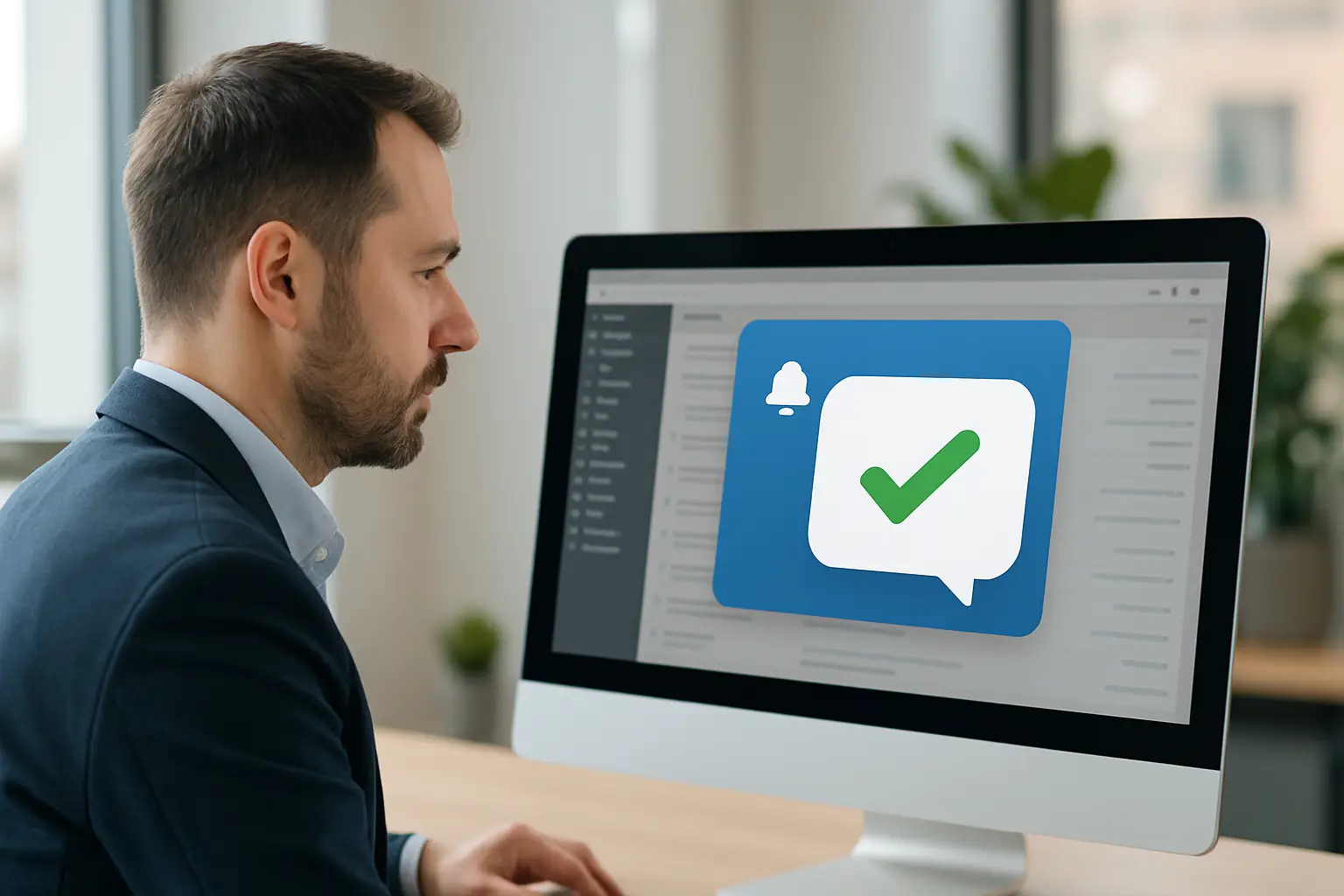
Notifications are your “act now” lane. They work for urgent IT notices, service outages, security alerts, building closures, and time-sensitive actions like benefits deadlines.
The trade-off is trust. If you overuse notifications, employees tune out fast. Desktop communication only stays effective when you protect urgency and avoid turning every update into a popup.
What to look for in employee desktop communication software
The category is easy to describe and surprisingly easy to get wrong in practice. The difference is usually not the surface features. It is the operating model.
Central control with local relevance
You need one place to publish and govern content, with the ability to target by department, location, role, or device group. Company-wide messages should be simple to push, but team-specific updates should be just as easy. Relevance is what keeps attention.
If a platform forces everything into a single global feed, you will either spam everyone or stop using it.
Fast creation that fits your real workflow
Internal comms teams do not fail because they lack ideas. They fail because they lack time.
Look closely at the creation workflow. If every slide requires a designer or a complex template tool, your cadence will drop. The best systems align with what communicators already use, so publishing becomes routine rather than a special project.
Proof, not assumptions
If you cannot measure views or confirmation of reads (especially for notifications), you will eventually lose stakeholder confidence. Leaders will ask, “Did people see it?” and you will fall back to guesses.
Choose software that treats communications like an accountable system. Tracking changes behavior inside the organization: content becomes clearer, targeting becomes smarter, and leadership learns what actually lands.
IT-friendly deployment and governance
IT teams are not looking for “yet another app.” They are looking for predictable rollout, minimal endpoint risk, and manageable administration.
Cloud hosting helps, but only if the vendor takes responsibility for the environment and updates. On the endpoint, the lightweight agent should be stable, easy to deploy, and easy to maintain. And you will want clear controls for branding, content approval, and scheduling.
Brand consistency without bottlenecks
Your desktop is a visible part of the employee experience. If each site or team improvises, you get inconsistent messaging and visual clutter.
Look for strong templates, brand controls, and guardrails that let many people contribute without creating chaos. The goal is scale with governance.
A practical rollout approach that sticks
Most internal comms tools fail at the same point: after the launch email.
Start with a narrow set of use cases that solve a real problem, then expand once people trust the channel.
A sensible first month often includes one weekly wallpaper or screensaver series (priorities, KPIs, recognition), plus notifications only for genuinely urgent items. That combination trains employees to expect value without feeling interrupted.
From there, build a steady rhythm. Monthly campaigns work well on desktops because repetition is easy. You can reinforce a benefits window, a safety initiative, a leadership message, or a site event without asking employees to “go somewhere.” The desktop becomes the place where alignment lives.
Also decide who owns the channel. Many organizations do best with internal comms or HR owning governance and standards, while operations and IT have targeted publishing rights for their lanes. Clear roles keep the channel clean.
When desktop communication is the right choice – and when it is not
Desktop messaging is a strong fit when you need broad reach across a varied workforce, especially when email and chat are saturated. It is also a practical solution when you want to standardize messaging across locations while still allowing local targeting.
It is not the best choice if most of your employees do not work on computers, or if your primary need is two-way discussion rather than broadcast. In those scenarios, mobile-first tools, team collaboration platforms, or digital workplace communities may do more of the heavy lifting.
Many organizations end up with a hybrid: desktop messaging for reliable broadcast and reinforcement, plus email and chat for depth and collaboration.
A note on tools and why PowerPoint matters
One of the biggest adoption levers in this category is whether non-designers can publish quickly while staying on brand.
If your communicators can build content in a tool they already know, you remove the friction that slows everything down. That is why some organizations choose platforms like ConnectedCompany, which lets teams create and deploy branded desktop content using PowerPoint and manage it centrally, with engagement tracking that shows what was viewed and which notifications were read.
The operational takeaway is simple: if content creation is hard, usage drops. If publishing is fast, the channel stays alive.
Closing thought: treat the employee desktop like a communication asset you already own. When you manage it with the same discipline you apply to brand, security, and operations, your messages stop competing for attention and start setting direction.